
Cradle of civilisations
Türkiye, cradle of civilisations
Patients come to Türkiye for treatment, and many have time between appointments. These places turn that time into a journey through ancient cities, sacred landscapes, Ottoman monuments and living villages.
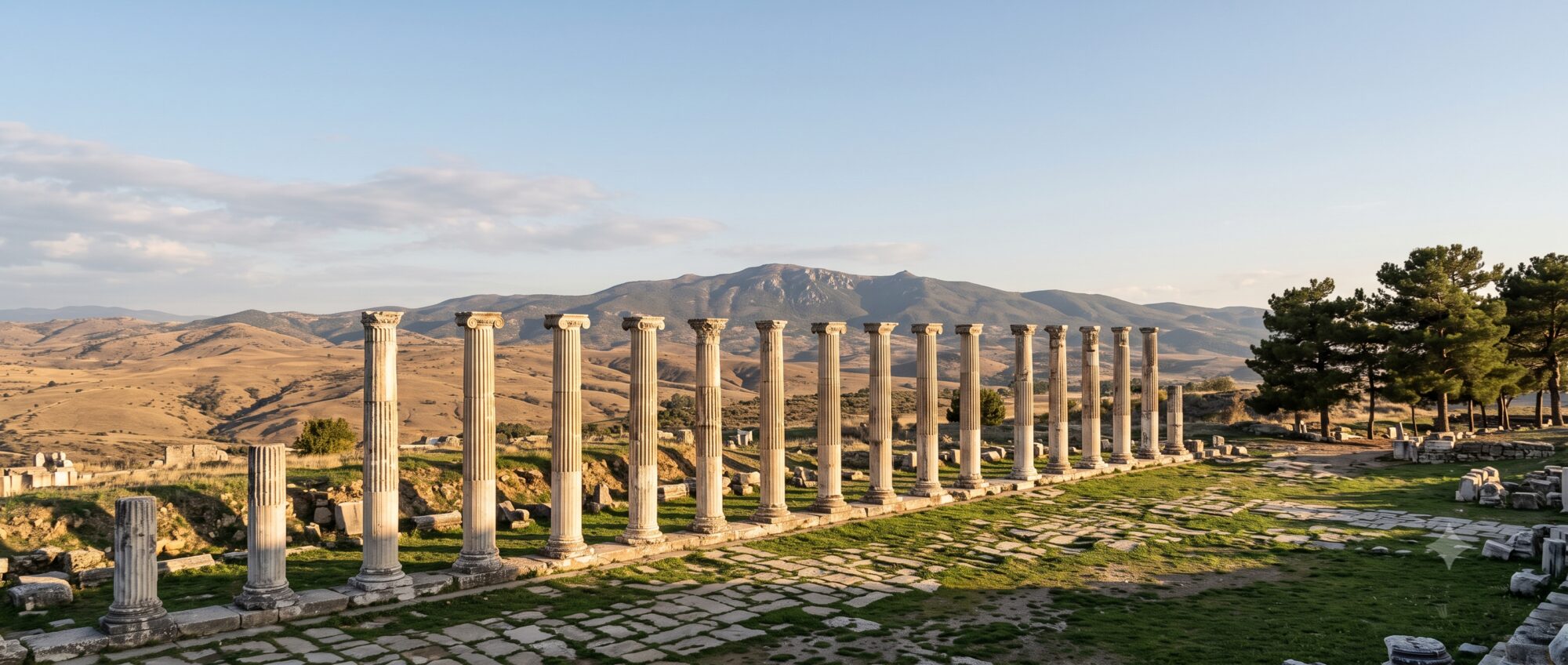
Izmir province
Pergamon (Bergama)
Medicine was practised here 2,000 years before the modern clinic.
The Asklepion of Pergamon was one of the great healing centres of the ancient world — and the city where Galen, the physician whose ideas shaped medicine for the next fourteen centuries, was born and trained.
Read more
Manisa province
Sardis (Sart)
The place where money was invented.
Sardis was the capital of Lydia and the place where the world's first standardised coins were struck in the 7th century BC — the beginning of money as we use it today.
Read more
Izmir province
Ephesus (Efes)
A great classical city — and a place of pilgrimage.
Ephesus holds the Library of Celsus, the site of the Temple of Artemis — one of the Seven Wonders of the ancient world — and, on the hill above, the house where tradition holds the Virgin Mary spent her final years.
Read more
Şanlıurfa province
Göbeklitepe
Seven thousand years older than the pyramids.
Göbeklitepe is the oldest known monumental sanctuary on earth — raised around 9600 BC, before pottery, metal, writing or the wheel existed.
Read more
Nevşehir province
Cappadocia (Fairy Chimneys)
A landscape people carved into homes, churches and cities underground.
Volcanic ash hardened into soft rock; wind and water shaped it into the cones known as fairy chimneys. Then people carved into them — dwellings, monasteries and entire cities below the surface.
Read more
Muğla province
Kaunos Rock Tombs (Dalyan)
Temple-fronted tombs watch over the reed channels of the Dalyan delta.
Kaunos was a Carian port whose harbour slowly silted up. Its most recognisable remains are the rock-cut tombs above Dalyan, carved like small Hellenistic temples into the cliff.
Read more
Izmir province
House of the Virgin Mary
A quiet pilgrimage site shared by Christian and Muslim visitors.
On Bülbül Mountain above Ephesus, a small stone house is revered by tradition as the final home of Mary. The sanctuary draws pilgrims for prayer, reflection and the spring below the chapel.
Read more
Antalya province
Ancient City of Side
Roman streets and temples reach the edge of the Mediterranean.
Side occupies a small peninsula south of Manavgat. Once Pamphylia's leading port, it preserves a Roman theatre, colonnaded streets, baths and the Temple of Apollo beside the ancient harbour.
Read more
Konya province
Mevlana Museum
Rumi's tomb and the memory of the Mevlevi order beneath the Green Dome.
The former Mevlevi lodge in central Konya is now the Mevlana Museum. Its focus is the tomb of Jalal al-Din Rumi, surrounded by manuscripts, musical instruments and objects from lodge life.
Read more
Trabzon province
Sümela Monastery
A monastery fixed to a cliff, three hundred metres above a forested valley.
Sümela rises on the rock face above Altındere Valley in Maçka. Its cave church, chapels, cells, guest rooms and water system form a monastic complex shaped by centuries of building and repair.
Read more
Denizli province
Hierapolis–Pamukkale
A Greco-Roman spa city built beside white terraces made by thermal water.
At Pamukkale, calcium-rich hot springs created white travertine terraces while Hierapolis grew beside them as a spa and sacred city. Nature and archaeology were inscribed together by UNESCO in 1988.
Read more
Mardin province
Mardin Castle
A long citadel crowns the ridge above Mardin's stone city.
Mardin Castle stretches along the rocky summit above the old city. Its date remains debated; the official inventory points to a probable 10th-century Hamdanid phase and traces from later Akkoyunlu rule.
Read more
Çanakkale province
Troy
Nine archaeological layers beneath the city of Homer's Iliad.
Troy is both an archaeological mound occupied for millennia and the setting that shaped the Iliad. Its walls, gates and foundations reveal nine broad cultural layers from the Early Bronze Age to the Roman city of Ilion.
Read more
Bursa province
Green Tomb (Yeşil Türbe)
Turquoise tiles turned an Ottoman sultan's tomb into Bursa's colour landmark.
Built for Sultan Mehmed I in 1421, the octagonal Green Tomb stands above the Green Mosque complex. Its turquoise exterior tiles and richly worked interior belong to Bursa's early Ottoman architectural landscape.
Read more
Aydın province
Aphrodisias
A Roman city whose nearby marble made its sculptors famous across the empire.
Aphrodisias grew around the sanctuary of Aphrodite in the Morsynus valley. Abundant local marble supported an exceptional school of sculpture and left civic buildings, reliefs and inscriptions in remarkable condition.
Read more
Ankara province
Ankara Castle
Ankara's long history is built into the stones of its hilltop citadel.
Ankara Castle encloses the summit above Ulus with inner and outer walls. Roman repairs, Byzantine defences, Seljuk inscriptions and Ottoman houses show how each period reused the same strategic hill.
Read more
Izmir province
Agora of Smyrna
A Roman civic centre survives between Kemeraltı and Kadifekale.
The Agora of Smyrna was the administrative, commercial and religious centre of ancient Smyrna. Most visible remains date from the 2nd century AD, when the complex was rebuilt after a destructive earthquake.
Read more
Izmir province
Şirince
A hillside village of whitewashed houses, orchards and exchanged memories.
Eight kilometres above Selçuk, Şirince preserves a dense hillside pattern of traditional houses and narrow lanes. Its story moves from a prosperous 19th-century Greek settlement through the 1923 population exchange to today's village of orchards, wine and tourism.
Read more
Planning treatment and a few days to look around?
Tell us what you need. We will send you clinic options and starting prices — free, without obligation.
Get a free quote